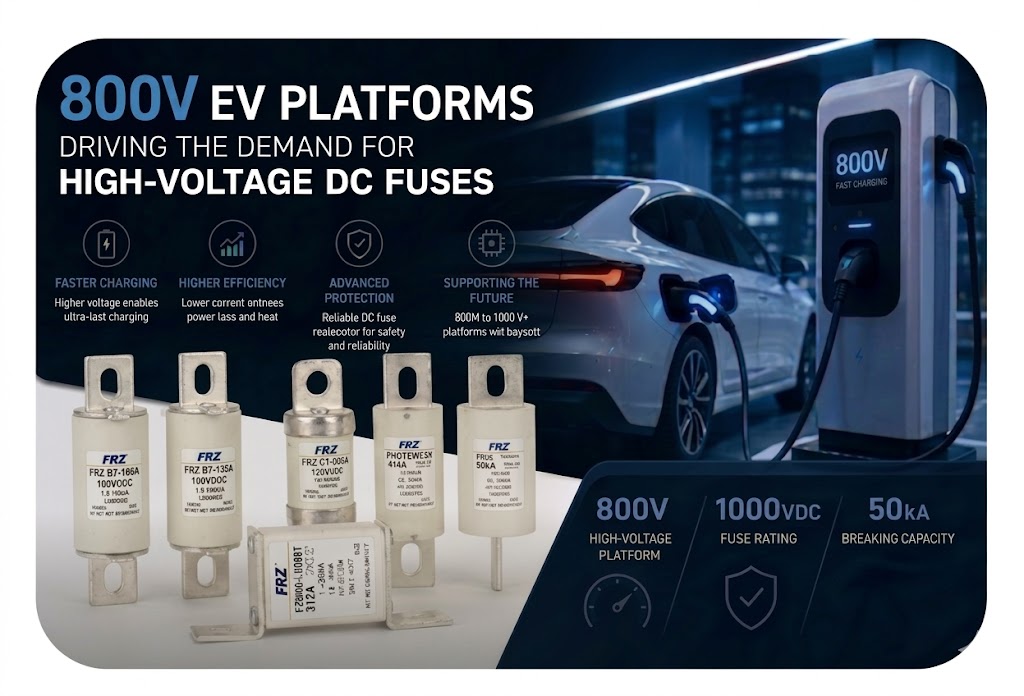
The electric vehicle industry is rapidly transitioning from traditional 400V architectures to 800V high-voltage platforms.
Major EV manufacturers are increasingly adopting 800V systems to improve:
As this trend accelerates, demand for high-voltage DC fuse protection is also growing.
Higher voltage systems provide significant advantages for modern EVs.
Using the equation:
P=V×IP = V \times I
Increasing voltage reduces current for the same power level.
This helps:
800V platforms also support ultra-fast charging, making them increasingly attractive for next-generation electric vehicles.
One of the biggest drivers behind 800V adoption is DC fast charging.
Compared with 400V systems:
Many modern EV platforms are now targeting charging times below 20 minutes.
This creates higher requirements for:
As voltage increases, DC fault interruption becomes more challenging.
Unlike AC systems, DC current does not naturally pass through zero, making DC arcs harder to extinguish.
In 800V systems:
This significantly increases the importance of reliable high-voltage DC fuse technology.
Modern EV fuse designs must adapt to:
Traditional EV systems often used:
800V platforms increasingly require:
Modern traction inverters use highly sensitive:
These components require ultra-fast fault protection with low energy let-through.
Higher voltage means:
Fuse structures must improve:
800V battery systems introduce additional protection challenges:
Battery protection now requires:
The EV industry is already moving beyond 800V.
Some high-performance and commercial vehicle platforms are beginning to adopt:
This trend is increasing demand for:
The rise of 800V vehicles also affects charging systems.
Fast charging stations now require:
As charging power continues increasing, DC fuse requirements become more demanding across the entire EV ecosystem.
The industry is expected to continue evolving toward:
These trends will further increase the importance of advanced DC fuse technology.
The transition from 400V to 800V EV platforms is reshaping the requirements for DC protection systems.
Higher voltage architectures improve:
But they also create more demanding conditions for fault interruption and semiconductor protection.
As EV technology continues evolving, high-voltage DC fuses will play an increasingly critical role in ensuring system safety and reliability.
Why are EVs moving to 800V systems?
800V systems improve charging speed, reduce current, and increase efficiency.
Do 800V EVs require different fuses?
Yes. Higher voltage systems require higher-rated DC fuse protection with improved arc interruption capability.
Why are 1000V DC fuses becoming important?
As EV platforms continue increasing in voltage, higher-rated fuse designs are needed for safe operation.
What is the advantage of lower current in 800V systems?
Lower current reduces heat generation and power loss while improving charging performance.

We use cookies to enhance your browsing experience, serve personalized ads or content, and analyze our traffic. By clicking "Accept All", you consent to our use of cookies.
 EN
EN ES
ES