 Why Fuse Selection Matters in BESS
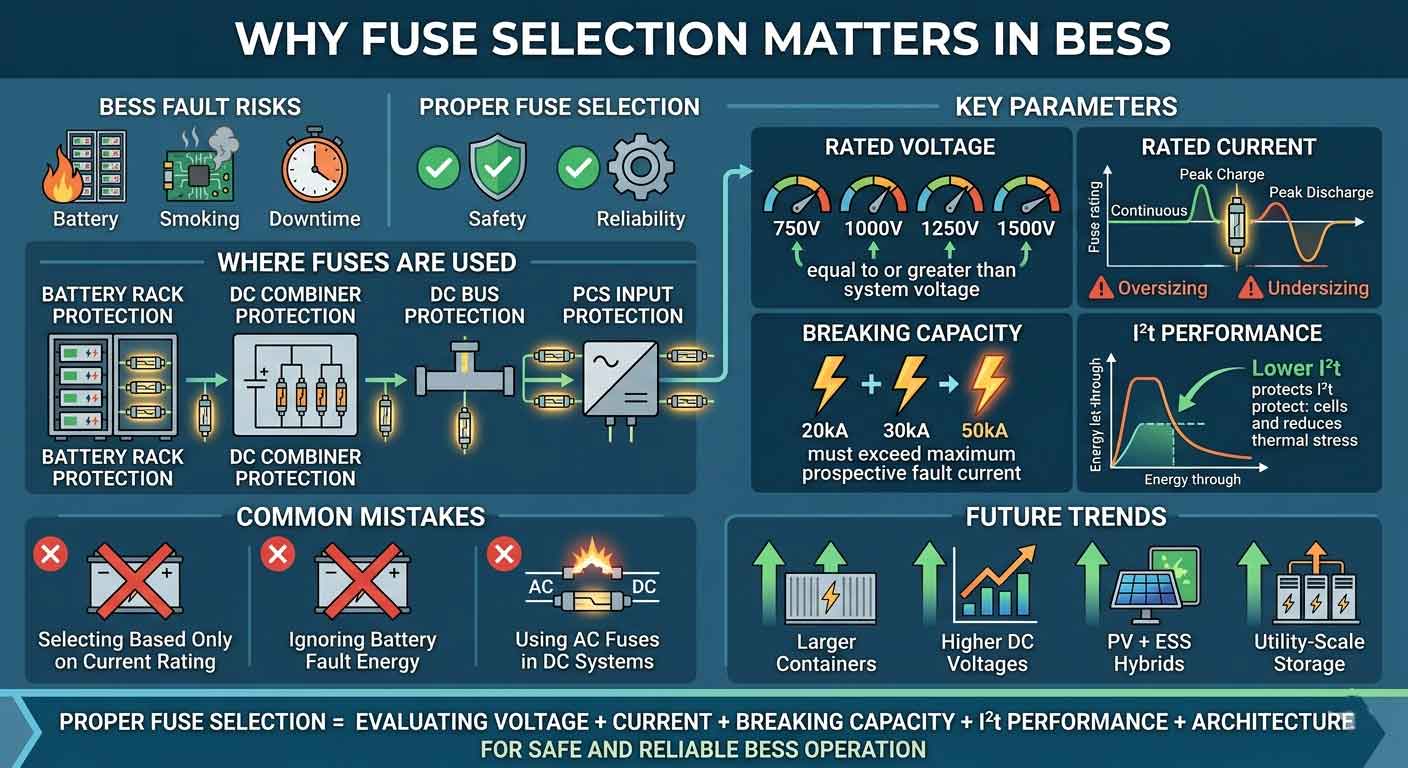
Battery Energy Storage Systems contain large amounts of stored energy.
A fault inside a battery rack or DC bus can result in:
Proper fuse selection helps ensure safe operation and reliable protection.
Typical fuse locations include:
Protects battery modules and rack-level circuits.
Protects parallel battery strings.
Protects power conversion systems from fault currents.
Provides system-level fault isolation.
Modern BESS systems commonly operate at:
The fuse voltage rating must always be equal to or greater than system voltage.
The fuse must withstand:
Oversizing reduces protection effectiveness.
Undersizing causes nuisance operation.
Large battery systems can produce substantial fault current.
Typical requirements:
Breaking capacity must exceed the maximum prospective fault current.
I²t determines how much energy passes before the fuse clears.
Lower I²t helps:
Current rating alone is not enough.
Voltage rating and breaking capacity are equally important.
Battery systems can release extremely high fault current.
Fault calculations should always be performed.
AC fuses are not designed to interrupt high-voltage DC arcs.
System Parameters:
Selection Considerations:
The BESS industry is moving toward:
These trends are increasing demand for high-performance DC fuse protection.
Choosing the correct fuse for BESS applications requires evaluation of:
Proper fuse selection is essential for safe and reliable battery energy storage operation.

We use cookies to enhance your browsing experience, serve personalized ads or content, and analyze our traffic. By clicking "Accept All", you consent to our use of cookies.
 EN
EN ES
ES